
You just bought a new-build home in Calgary. It looks spectacular. Open-concept kitchen, quartz countertops, potlights everywhere, massive windows flooding the rooms with natural light. Then January hits. The windows are ice-cold to the touch. Condensation streams down the glass every morning. Your furnace runs constantly, and the energy bills are double what you expected. You call the builder. They tell you everything meets code. They're right. And that's the problem.
What Is "Builder Grade"?
What goes into your new home is something the industry calls "builder grade." This is perhaps the most important phrase in the entire Canadian real estate conversation — and almost nobody talks about it.
Builder grade is not a certification. It is not an industry standard published by the Canadian Standards Association or the National Building Code. It is a phrase the industry invented to describe the minimum quality product that legally satisfies code, transfers the deed, and ends the builder's liability the moment you hand over your deposit.
Builder grade means built to pass inspection, not built to last. Those are two completely different things — and the gap between them is where your money disappears.
There is a loophole in Canada's window certification system that allows volume builders to install the cheapest possible windows in brand-new homes and pass every inspection. It comes down to two numbers most homeowners have never heard of: Energy Rating (ER) and U-factor. Understanding the difference between them is the single most important thing you can learn before buying a new-construction home in Calgary, and almost nobody is talking about it.
Two Numbers That Decide Your Comfort: Energy Rating vs. U-Factor
Every window sold in Canada is tested under the CSA A440.2 standard and assigned performance ratings. Two of those ratings matter most for your comfort and energy bills, but they measure fundamentally different things.
U-Factor: Pure Insulation
U-factor measures how much heat passes through a window, expressed in watts per square metre per degree Kelvin (W/m²K). The lower the number, the better the insulation. A U-factor of 1.22 means less heat escapes than a U-factor of 1.65. It's straightforward, consistent, and works the same way regardless of which direction your window faces, whether it's sunny or cloudy, day or night.
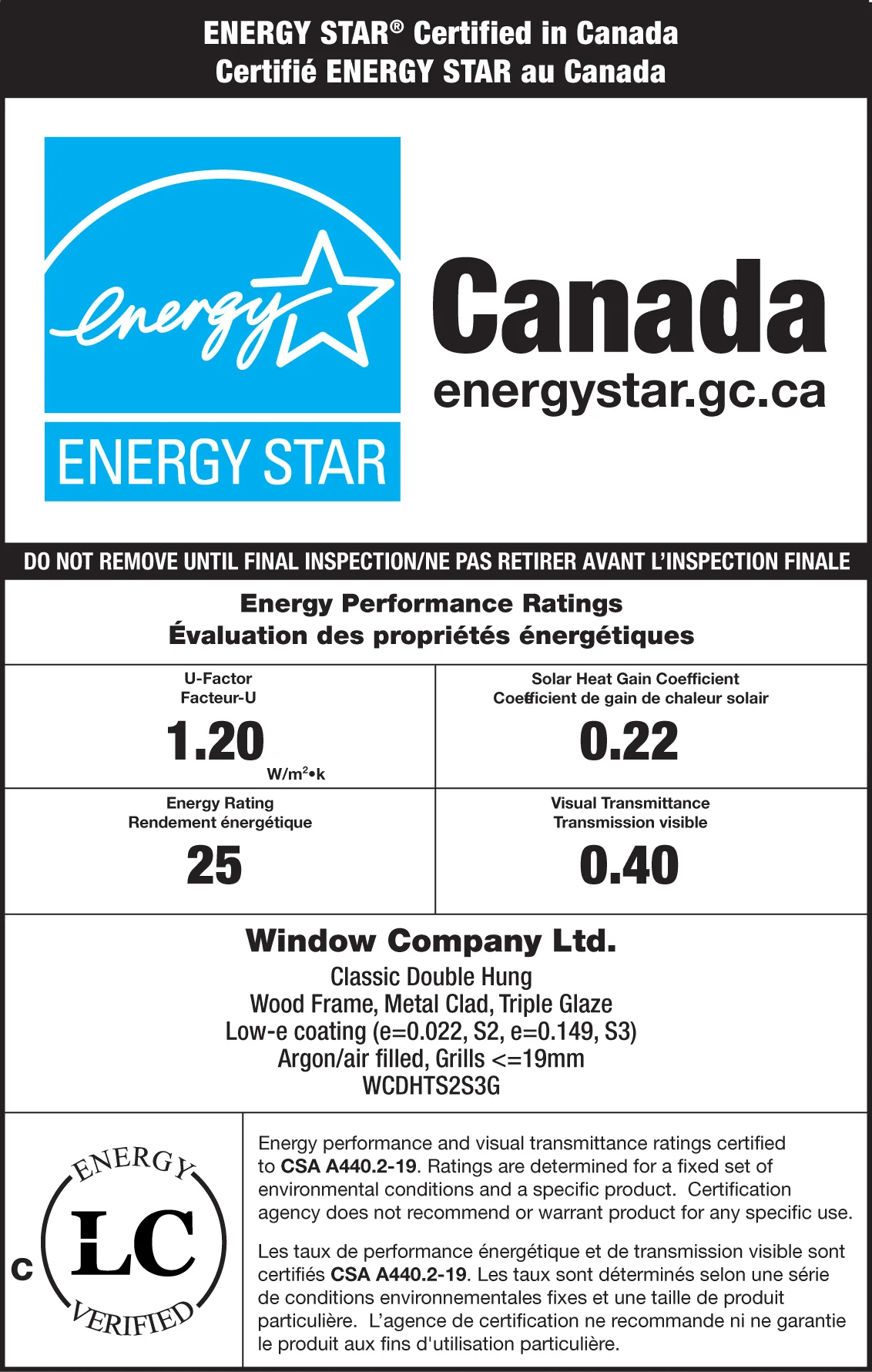
Think of U-factor like the R-value of your walls. It simply tells you how well the window resists heat flow. A window with a U-factor of 1.22 or lower qualifies as ENERGY STAR certified in Canada. A U-factor of 1.05 or lower earns the "Most Efficient" designation from Natural Resources Canada.
Energy Rating (ER): The Combined Score
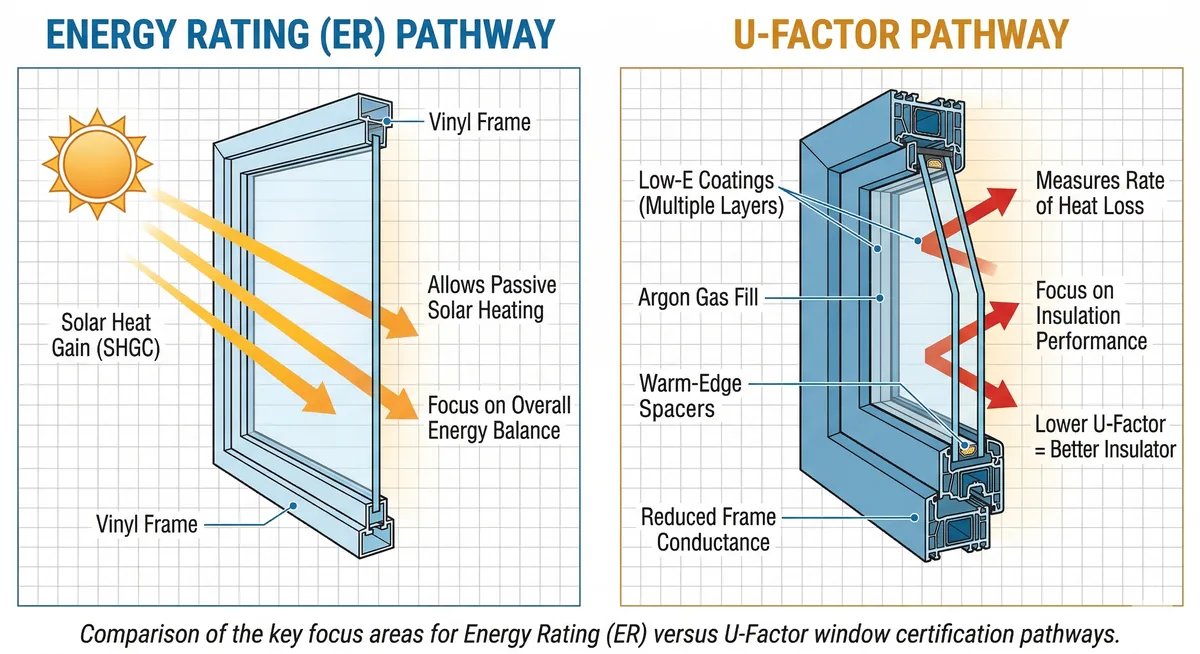
Energy Rating is a calculated number that combines three factors: U-factor (insulation), Solar Heat Gain Coefficient (SHGC, how much radiant heat from the sun passes through the glass), and air leakage. The formula weighs solar heat gain heavily. In fact, the SHGC is multiplied by 57.76 in the equation, while U-factor receives a multiplier of only 21.90. That means solar heat gain counts for more than double the weight of insulation in determining a window's Energy Rating.
The idea behind this is "passive solar heating." If sunlight passes through the window and heats your home, that's free energy. In theory, a window that lets in a lot of solar heat could reduce your heating costs.
Here's Where It Falls Apart
To qualify for ENERGY STAR certification in Canada, a window needs either a U-factor of 1.22 or lower, or an Energy Rating of 34 or higher. Not both. Just one. This "or" is where the loophole lives. A window can have poor insulation (high U-factor) and still pass with a high Energy Rating, simply because it lets in a lot of solar heat.
Why Energy Rating Is Misleading in Calgary
Passive solar heating sounds logical on paper. Sunlight comes through the glass, warms your room, and reduces heating demand. But the real-world conditions in Calgary expose the serious flaws in relying on Energy Rating as a measure of window quality.
It Only Works Under Perfect Conditions
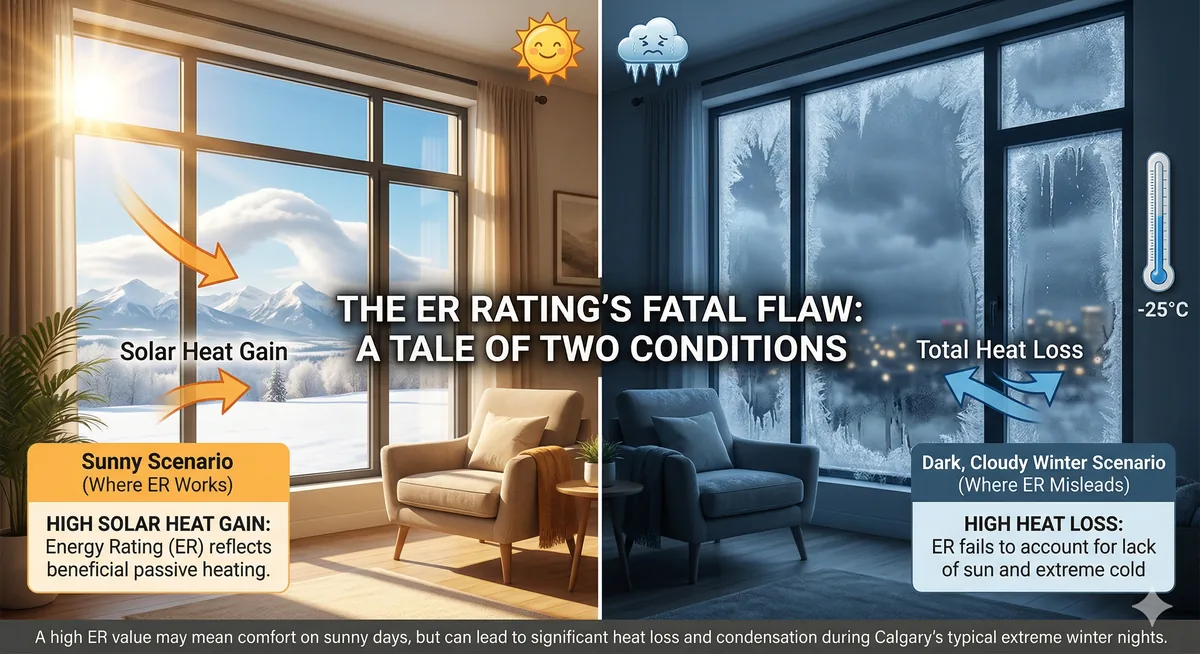
For passive solar heating to meaningfully contribute, you need direct sunlight hitting the window surface. In Calgary, that means clear skies, no trees or overhangs blocking the sun, and the window must face south or southwest. Now consider how often all those conditions align during Calgary's winter. December and January days are short, roughly 8 hours of daylight. Calgary is often overcast in winter. Not every window faces south. Most homes have trees, fences, neighbouring houses, eaves, and awnings that cast shadows.
The potential solar gain is limited to just a few hours per day during short winter days, and only when it's sunny and the south-facing window isn't shaded. That leaves roughly 16 to 20 hours per day when passive solar heating contributes absolutely nothing. During those hours, you're relying entirely on insulation, and an Energy Rating score won't tell you how much insulation you actually have.
North-Facing Windows Get Nothing
Here's the detail that makes the Energy Rating especially misleading: the ER number is calculated using a standard test that assumes solar exposure. But north-facing windows in Calgary receive virtually zero direct sunlight in winter. An east-facing bedroom window gets maybe an hour of direct morning sun. A window shaded by the house next door gets none. The Energy Rating assigns the same score to a south-facing window in an open field and a north-facing window behind a two-storey neighbour. In the real world, their thermal performance is drastically different.
Summer: The Reverse Problem
A window designed to maximize solar heat gain doesn't stop working in July. The same glass that's supposed to provide "free heat" in winter turns your home into a greenhouse in summer. Calgary sits at 1,045 metres elevation with intense UV exposure. A high-SHGC window on a west-facing wall will bake that room from 3 PM to 9 PM every summer evening. Your air conditioning runs overtime. The "free heat" in winter becomes expensive cooling in summer.
The Bottom Line
Energy Rating bundles insulation and solar gain into a single number. You have no way to tell whether a window with an ER of 34 earned that score through genuine insulation or through solar heat penetration that only works a few hours per day, on certain windows, during certain months.
How Volume Builders Exploit the Energy Rating System
Now you understand why the Energy Rating system matters. Here's how it plays out in the new-construction market across Calgary and Alberta.
Volume builders are logistics operations. Their business model depends on building hundreds or thousands of homes per year at the lowest possible cost per unit. Every material choice is a cost optimization decision. Windows are one of the biggest visible features in a home, but the buyer's attention focuses on size, style, and how much light they let in. Almost nobody walks into a show home and asks, "What's the U-factor on these windows?"
Because ENERGY STAR certification requires either a U-factor of 1.22 or an ER of 34, builders choose the cheaper path. Achieving an ER of 34 is relatively inexpensive. A basic double-pane window with thin vinyl frames, a metal spacer, and standard glass can hit ER 34 because the glass lets enough solar radiation through to boost the combined score. The heat coming in compensates for the heat leaking out, at least on the test sheet.
Achieving a U-factor of 1.22, on the other hand, requires real engineering: warm-edge spacers (foam or stainless steel instead of aluminum), Low-E coatings, argon or krypton gas fill, reinforced vinyl or fiberglass frames, and wider insulated glass units. All of that costs more.
What Builder-Grade Windows Actually Look Like
Based on what professional installers see when replacing windows in Calgary's newer subdivisions, here's what typically goes into a new-construction home:
- → Thin vinyl frames (2.5-inch profile): Unreinforced plastic that yellows and warps within 2 to 5 years of UV exposure. No steel or fiberglass reinforcement inside.
- → Aluminum spacers: The metal bar separating the glass panes is aluminum, which conducts heat rapidly. This creates a thermal bridge, the cold edge you feel on the inside of the glass. Ironically, this thermal bridge also lets more solar radiation through the edge, which actually helps the Energy Rating score.
- → Narrow glass units: Thinner air gaps between panes mean less insulation but lower material cost.
- → Minimal or no Low-E coatings: Low-E coatings reflect heat back into the room. Fewer coatings mean more heat loss but also more solar gain, which boosts ER.
- → Slider windows by default: Sliders are the cheapest window type to manufacture. No complex hardware, just two pieces of plastic sliding against each other with a single brush seal that wears out in a few years.
- → Rushed installation: Production framers are paid per house, not per hour. Air sealing around rough openings, which is critical for thermal performance, is frequently rushed, abbreviated, or skipped. A window that tests well in a lab leaks cold air through every frame joint when it's installed improperly.
The Result
New-construction homes across Calgary's newest communities have windows that are ice-cold in winter and scorching hot in summer. Condensation and even ice buildup on the interior glass is common. Utility bills are significantly higher than they should be. The windows meet code. They pass inspection. And within 2 to 5 years, the frames are yellowing, the seals are beginning to fail, and the homeowner is calling for a replacement quote on a home they haven't finished paying for.
The "Triple-Pane" Marketing Trick
Some builders have started advertising triple-pane windows as an upgrade or even standard in their new homes. This sounds like a premium feature. Three panes of glass must be better than two, right?
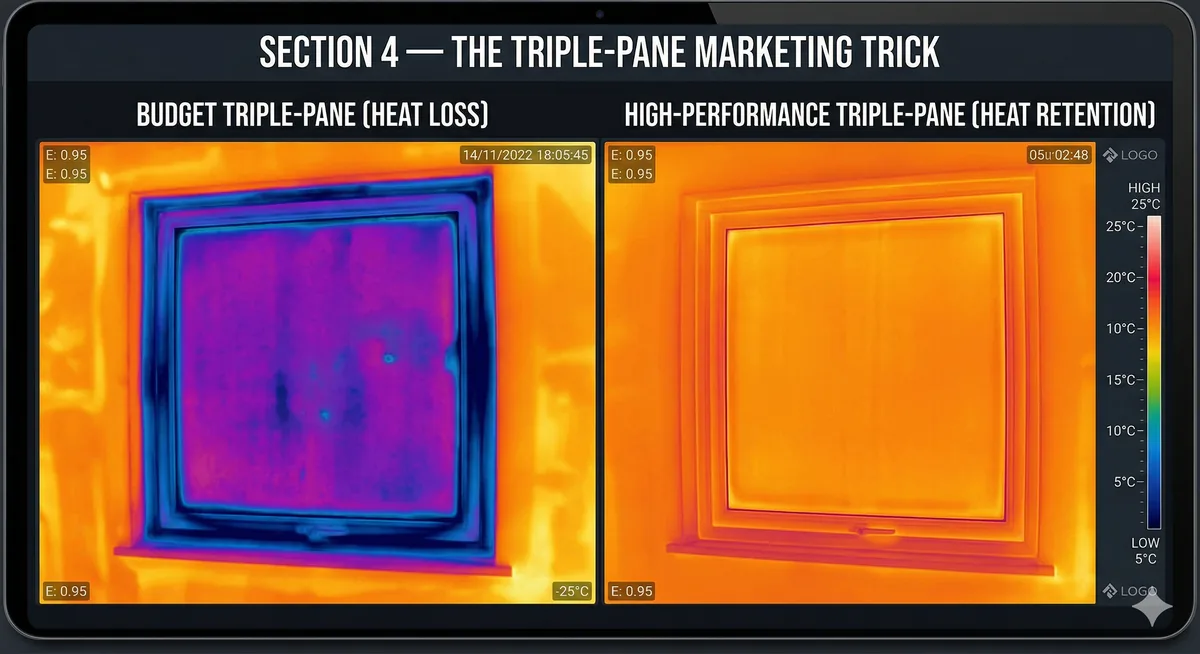
Not necessarily. The number of glass panes is only one factor in window insulation. A triple-pane window with the same aluminum spacer, the same narrow glass unit width, the same thin frame, and no additional Low-E coatings will perform almost identically to a double-pane window. Professional installers regularly verify this with infrared cameras during replacement consultations. The surface temperature reading on a cheap triple-pane window is often the same as an older double-pane unit.
That's because glass itself is not a great insulator. What makes a triple-pane window genuinely superior is the combination of technologies: wider spacer cavities filled with argon or krypton gas, warm-edge spacers made from foam or stainless steel, dual or triple Low-E coatings positioned on specific glass surfaces, and a reinforced frame wide enough to accommodate the thicker glass unit.
What "Triple-Pane" Should Actually Mean
A genuine high-performance triple-pane window for Calgary's climate should have: three panes of glass with two argon-filled cavities, warm-edge spacers (not aluminum), at least two Low-E coatings, a U-factor of 1.05 or lower, and a reinforced frame profile of 3.25 inches or wider.
If a builder advertises "triple-pane" but can't provide a U-factor below 1.22, that third pane of glass is doing very little for your comfort or energy bills. It's marketing, not performance.
What U-Factor Should Your Calgary Windows Actually Have?
Here's where it gets practical. Let's look at the numbers that actually matter for Calgary homes, based on Natural Resources Canada guidelines and real-world performance in our climate.
U-Factor Benchmark Chart for Calgary
Condensation, ice, high bills
Passes code, may still condense
No ice, reduced condensation
Comfort + efficiency
Calgary is technically in Climate Zone 2 under the old NRCan classification, with a minimum U-factor requirement of 1.4 for basic code compliance. But in practice, a U-factor of 1.4 is not sufficient for comfort. With regular winter temperatures dropping to -25°C and below, windows at that insulation level will condense and potentially form ice on the interior surface.
The Government of Canada recommends a U-factor of around 1.2 for Climate Zone 3 (colder regions like northern Alberta and Saskatchewan). Given Calgary's chinook temperature swings, which can shift 20 to 30 degrees in a single day and stress window seals and frames beyond what steady cold does, aiming for a U-factor of 1.2 or lower is the recommendation that consistently results in comfortable, condensation-free performance.
Not All Windows Should Be the Same
One detail that rarely comes up in window discussions: different windows in your home face different conditions and should be specified accordingly.
- • North-facing windows: Maximum insulation priority. These get zero passive solar gain. U-factor is the only number that matters here.
- • South-facing windows: Balance of insulation and controlled solar gain. Low-E coatings can be selected to allow some winter sun while blocking summer heat.
- • West-facing windows: Heat resistance is critical. Afternoon summer sun creates the worst overheating. Low SHGC coatings are important here.
- • Basement windows: Smaller openings with less exposure may need less insulation than main-floor windows, but proper air sealing is still essential.
Installing the same window specification on every opening is like putting all-season tires on every vehicle regardless of use. It works, but it's a compromise everywhere and optimal nowhere.
Why Builder-Grade Installation Fails Calgary Windows
Even if a builder installed a decent window, the installation practices on production job sites frequently undermine whatever thermal performance the window was designed to deliver.
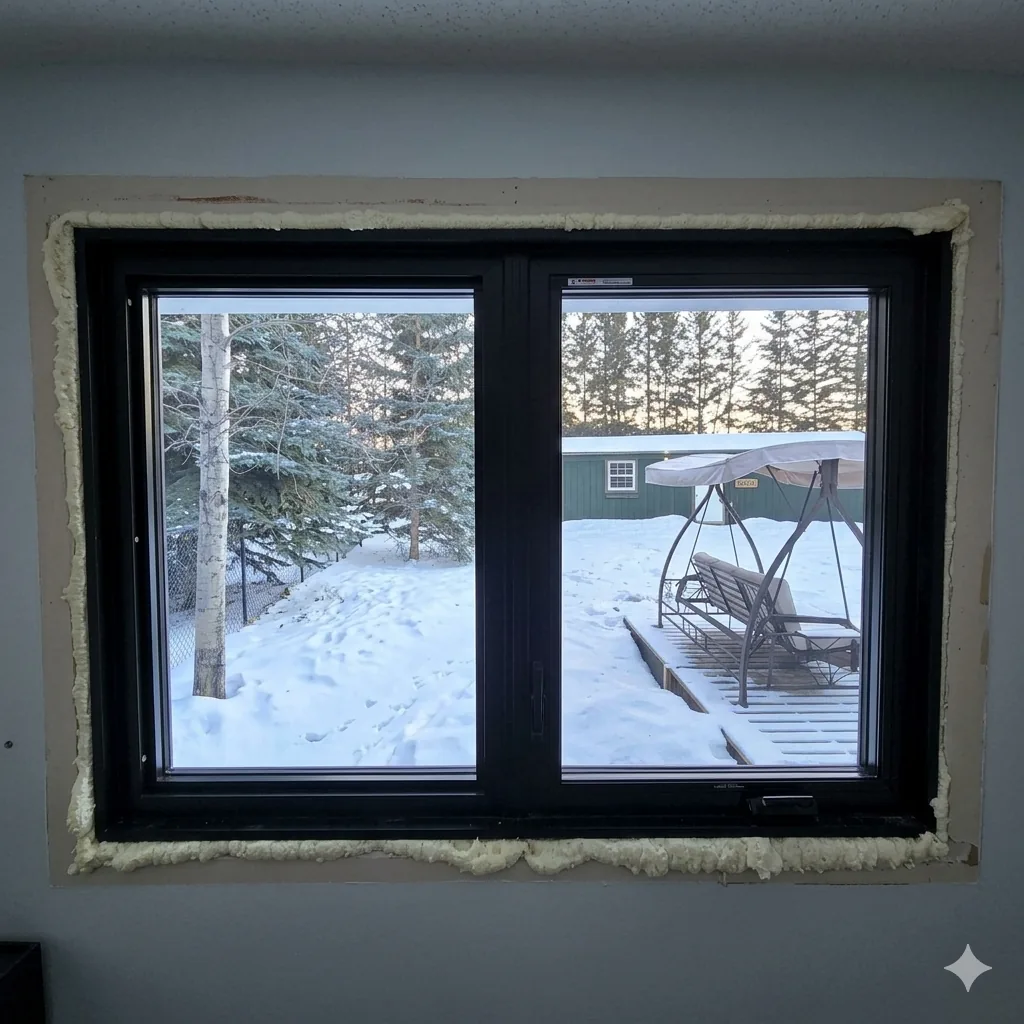
Proper window installation in a cold climate requires continuous air sealing around the entire rough opening before the interior trim goes on. This means closed-cell spray foam that maintains waterproofing characteristics even if cut or trimmed, flexible enough to move with the frame through seasonal expansion and contraction, and applied in an unbroken seal around the entire perimeter.
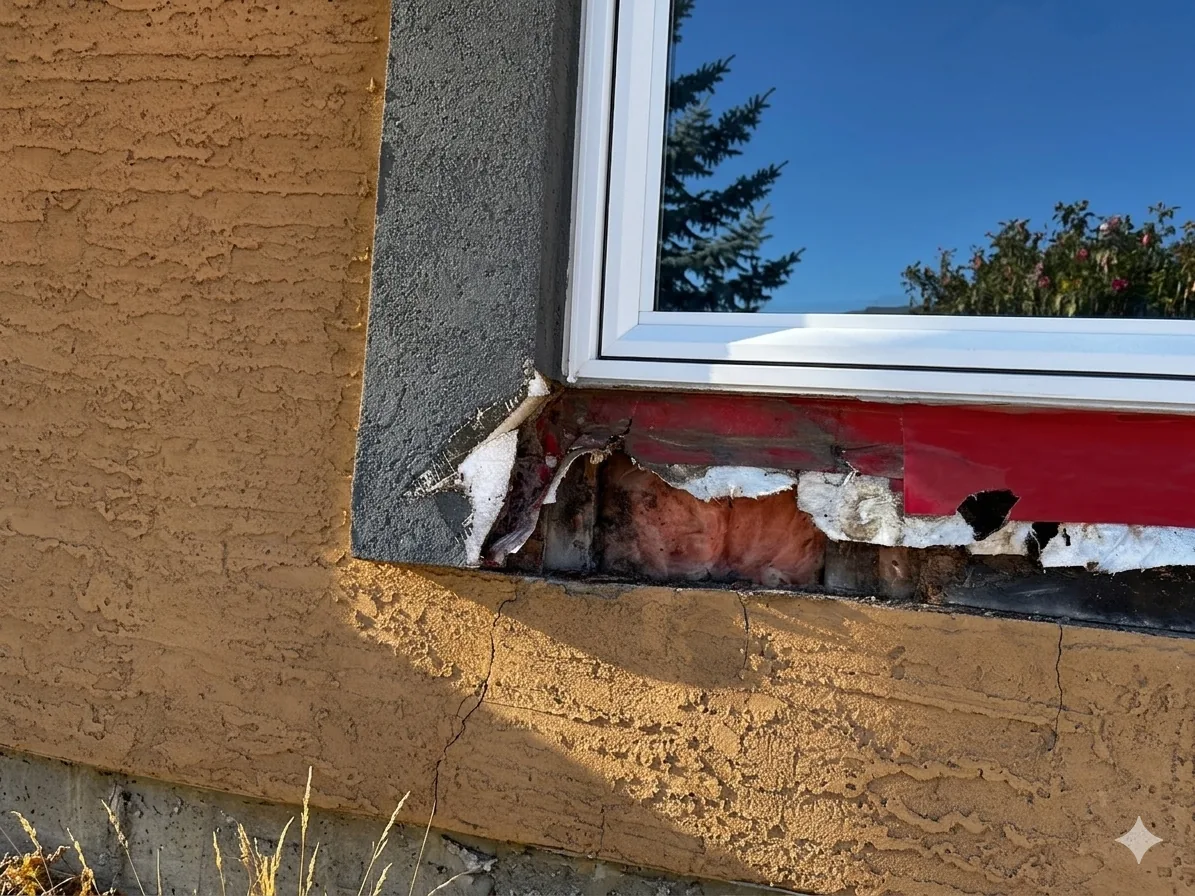
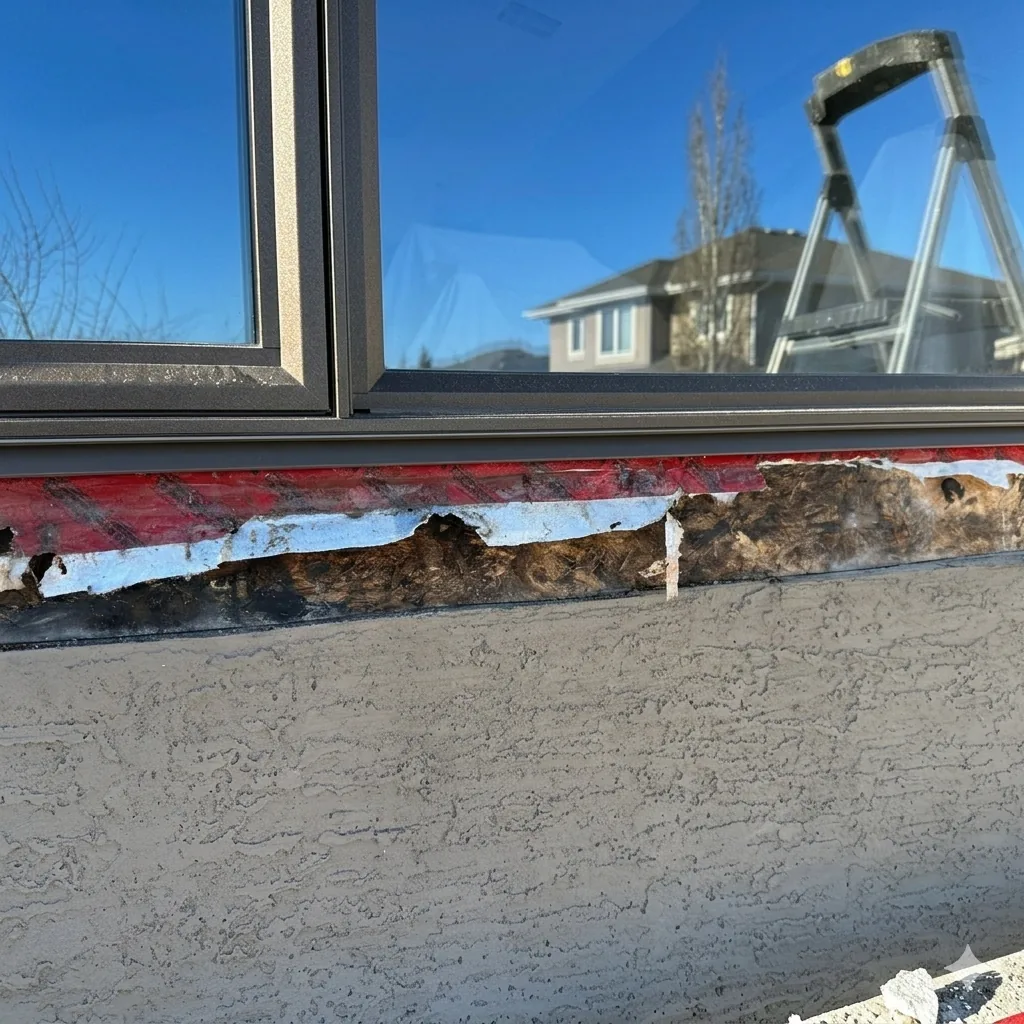
On a production site running 20 or 30 units simultaneously, framing crews are paid per house. Every minute spent perfecting a flashing detail or resealing a window penetration is an unpaid minute. The result is house wrap that overlaps incorrectly, flashing tape pressed onto wet lumber, and window rough openings that are never properly sealed before siding goes up.
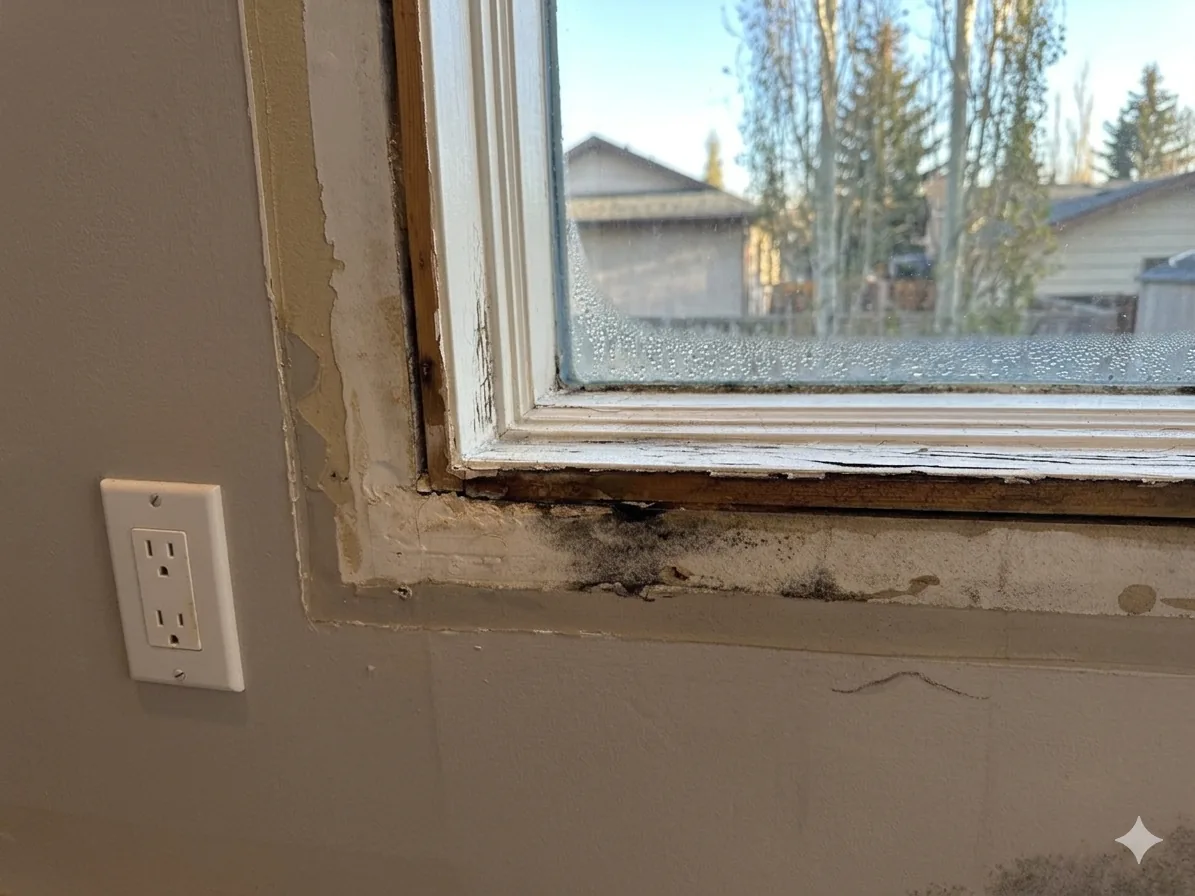
Water gets behind the building envelope, saturates the OSB sheathing (the structural panels behind your siding), and this happens slowly and invisibly for years. Meanwhile, air leaks around poorly sealed windows make your heating system work harder and create cold spots that trigger condensation exactly where the seal was missed.
The $400 Inspection That Could Save You Thousands
If you're buying new construction, hire an independent inspector for a pre-drywall inspection before the walls close up. This is the only moment in the entire construction process where you can actually see what you're buying: every unsealed penetration, every gap in the air barrier, every rushed window installation. It costs $400 to $600. After the drywall goes up, these defects become invisible until they become expensive.
The Warranty Problem: "Maintenance Issue"
New home warranties in Canada typically offer one year of coverage for defects, with extended periods for specific structural elements. Compare that to window manufacturers who offer 25 to 30 year warranties on their products when sold directly to consumers. The contrast is telling.
When homeowners report problems with their new-build windows, whether it's condensation, ice buildup, drafts near the frames, or water infiltration around the casing, the standard builder response is to classify it as a "maintenance issue." The burden shifts to the homeowner to prove the defect is construction-related, not caused by normal wear, high humidity, or improper use.
Professional installers regularly see the evidence when they replace these windows. OSB sheathing that's black with moisture damage, water staining on the rough framing, foam seals that were never applied in the first place. The builder's explanation is typically that the moisture came from inside the home, not from a construction defect. But if the moisture were coming from inside, the interior framing would show the damage first, not the exterior sheathing.
Understanding your warranty coverage in detail before you close is essential. Know exactly what's covered, what the exclusions are, how long the windows specifically are warranted, and whether the coverage is full or prorated over time. A prorated warranty means the builder pays progressively less for repairs as the years go on, which is another incentive for materials that last just long enough to outlast the coverage period.
What Calgary Homeowners Should Actually Do
If You're Buying a New-Build Home
- 1. Ask for the U-factor, not just the Energy Rating. If the sales centre can only provide an ER number, ask specifically for the U-factor. If they don't have it or deflect, that tells you something.
- 2. Request the window spec sheet. Every certified window has a product data sheet listing U-factor, SHGC, ER, and air leakage. Ask for it. Read it.
- 3. Book a pre-drywall inspection. $400 to $600 for an independent inspector to document every installation detail while the walls are still open.
- 4. Read the full warranty document. Not the brochure summary. The actual warranty. Look for exclusions, prorated schedules, and how "defect" vs. "maintenance" is defined.
- 5. Ask about the spacer material. Aluminum spacer = thermal bridge = condensation at the edges. Warm-edge spacers (foam, stainless steel, or fiberglass) are the standard for cold-climate performance.
What Proper Installation Looks Like
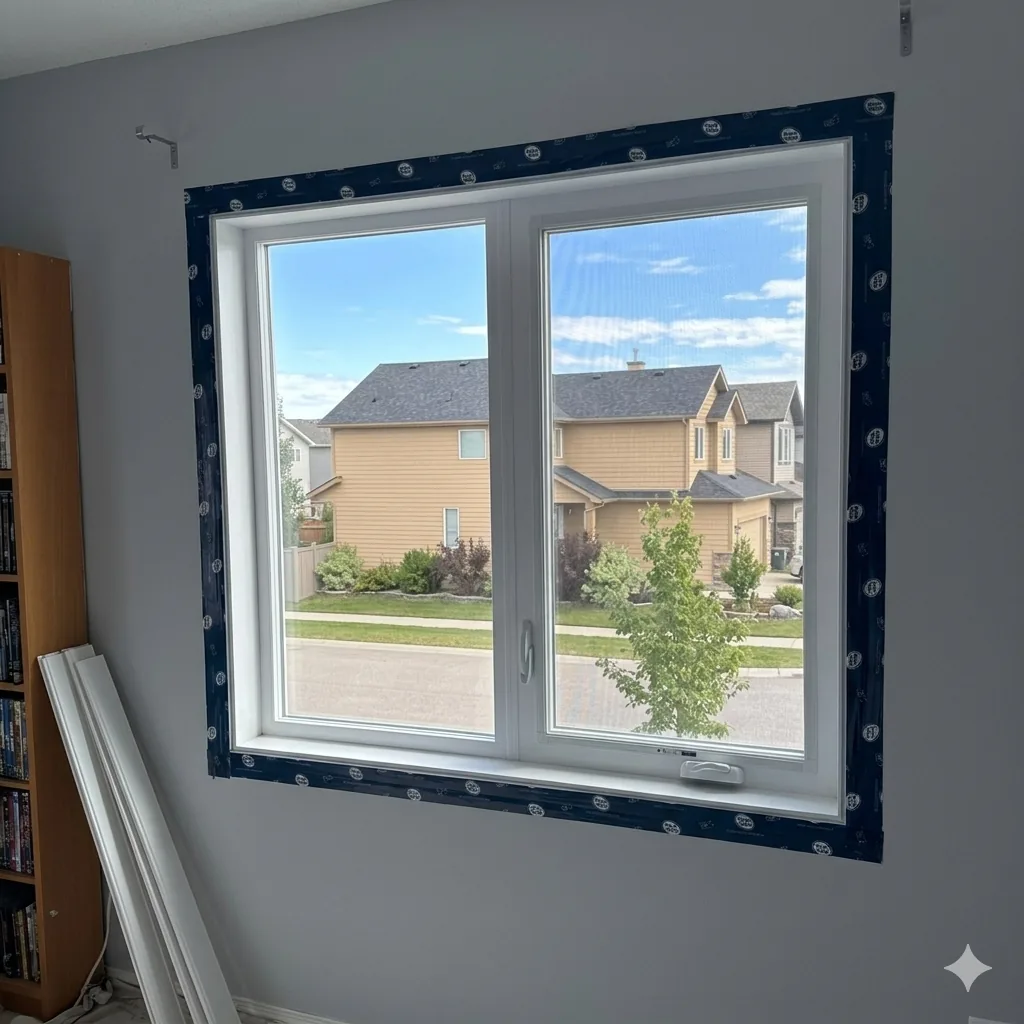
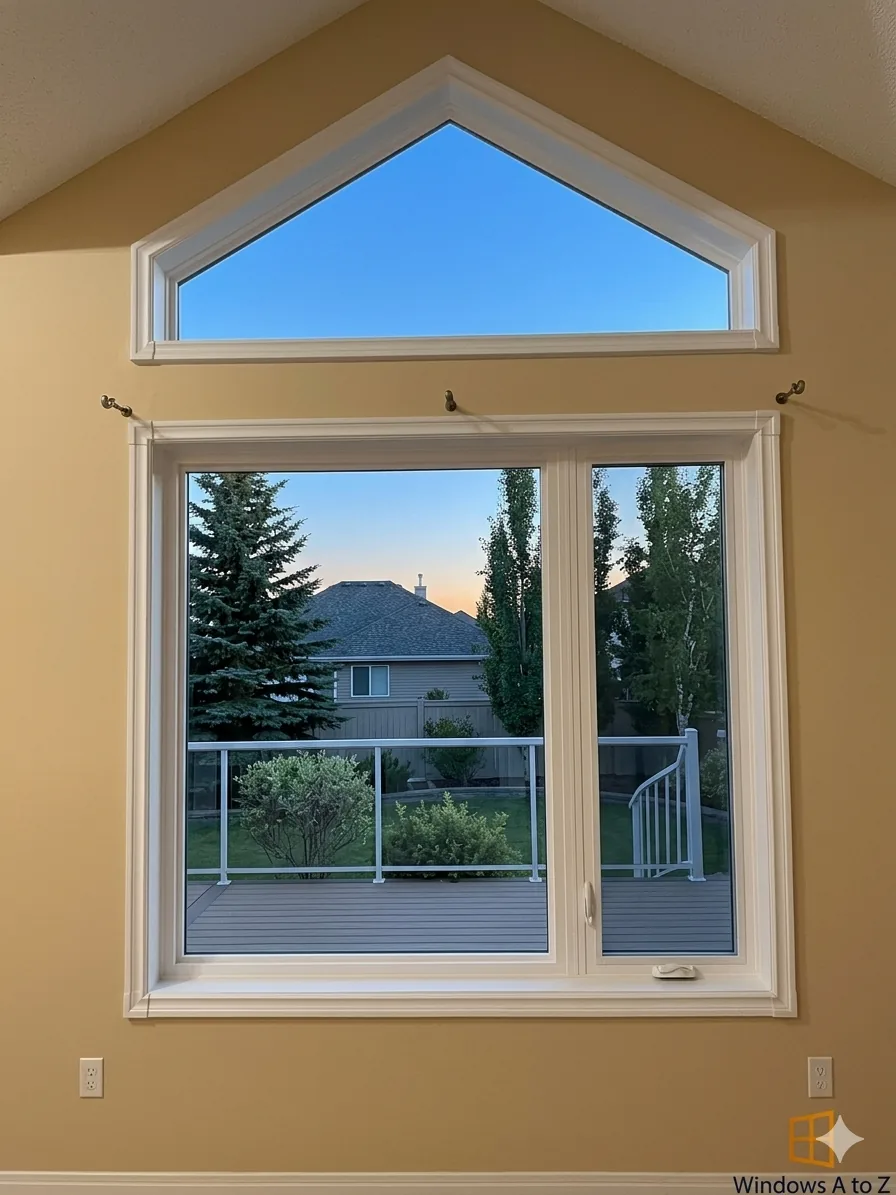
For comparison, here's what a quality window installation should look like at each stage:
If You Already Own a New-Build with Cold Windows
- 1. Check your window labels. Most windows have a sticker or etched marking with the U-factor and ER. If the U-factor is above 1.4, your windows are underperforming for Calgary's climate.
- 2. Get an infrared assessment. A thermal camera scan shows exactly where heat is escaping, whether it's through the glass, the spacer edges, or gaps in the installation seal.
- 3. Document everything. If you have condensation, ice, or draft issues, photograph them with dates. This documentation matters for warranty claims and for understanding the scope of the problem.
- 4. Consider replacement with proper specifications. Yes, it's painful to replace windows in a new home. But living with windows that don't insulate means paying inflated energy bills every month and dealing with moisture damage that compounds over time. A properly specified replacement window with a U-factor of 1.05 to 1.2 will transform your comfort and energy costs.
Energy Rating vs. U-Factor: Side-by-Side Comparison
| Factor | Energy Rating (ER) | U-Factor |
|---|---|---|
| What it measures | Combined insulation + solar gain + air leakage | Heat transfer rate (insulation only) |
| Better number is | Higher (34+ for ENERGY STAR) | Lower (1.22 or less for ENERGY STAR) |
| Works when sun is shining | Yes | Yes |
| Works at night / cloudy | Only the insulation portion | Yes, always |
| Works on north-facing windows | Overstates real performance | Accurate regardless of orientation |
| Affected by trees/shading | Yes, real performance drops | No, insulation is insulation |
| Cost to achieve minimum | Low (basic glass lets heat through) | Higher (requires coatings, gas, spacers) |
| Which builders prefer | ER (cheaper to hit the target) | Rarely chosen voluntarily |
| Which you should ask for | — | Always ask for U-factor |
Frequently Asked Questions
Your windows likely met building code through the Energy Rating pathway rather than the U-factor pathway. This means they passed inspection based partly on solar heat gain, not actual insulation. When there's no sun (nighttime, cloudy days, north-facing walls), the insulation alone isn't sufficient for Calgary's cold, and the interior glass surface drops below the dew point, causing condensation or ice.
Yes. Look for a sticker on the window frame (often between the panes on the spacer bar, or on the frame itself) that shows the ENERGY STAR certification details including U-factor and ER. You can also search the Natural Resources Canada Searchable Product List at nrcan.gc.ca with your window manufacturer and model number to find the certified ratings.
ENERGY STAR certification means the window meets the minimum threshold through either U-factor or Energy Rating. It doesn't tell you which pathway was used. A window certified through ER 34 with a U-factor of 1.65 is technically ENERGY STAR certified but will perform poorly in Calgary winters. Always ask for the specific U-factor number. If it's above 1.22, the certification came from the ER pathway.
Not automatically. A triple-pane window with aluminum spacers, no gas fill, and minimal coatings can perform the same as a double-pane under an infrared camera. The number of panes matters less than the complete specification: spacer material, gas fill, Low-E coatings, and frame quality. Ask for the U-factor of any triple-pane window. If it's not significantly lower than the double-pane alternative, the third pane is marketing.
For Calgary's climate, aim for a U-factor of 1.2 or lower. The ENERGY STAR minimum is 1.22, which is adequate. The Natural Resources Canada "Most Efficient" designation requires 1.05 or lower, which provides excellent comfort with virtually no condensation risk. For north-facing windows specifically, prioritizing the lowest U-factor you can afford makes the biggest difference in comfort.
If you're experiencing chronic condensation, ice buildup on interior glass, noticeably cold drafts near windows, or energy bills that seem high for your home's size, your windows may be underperforming. An infrared assessment can confirm whether the windows or the installation (or both) are the issue. Replacement with properly specified and installed windows typically pays for itself through energy savings over 7 to 12 years, plus the immediate improvement in comfort.
Have Questions About Your Windows?
Whether you're shopping for a new-build, wondering about your current window specs, or trying to understand why your new home is drafty, we're here to help. Drop us a question and we'll cover it in a future article.
Ask a QuestionRelated Articles
Window Condensation in Calgary: The Truth Most Companies Won't Tell You
Why condensation happens, when it's normal, and when it means your windows have failed.
Triple-Pane vs. Double-Pane Windows: What Calgary Homeowners Need to Know
Is the upgrade worth it? A detailed comparison for Calgary's extreme climate.
What Good Window Installation Actually Looks Like
Installation quality matters as much as window quality. Here's what to look for.